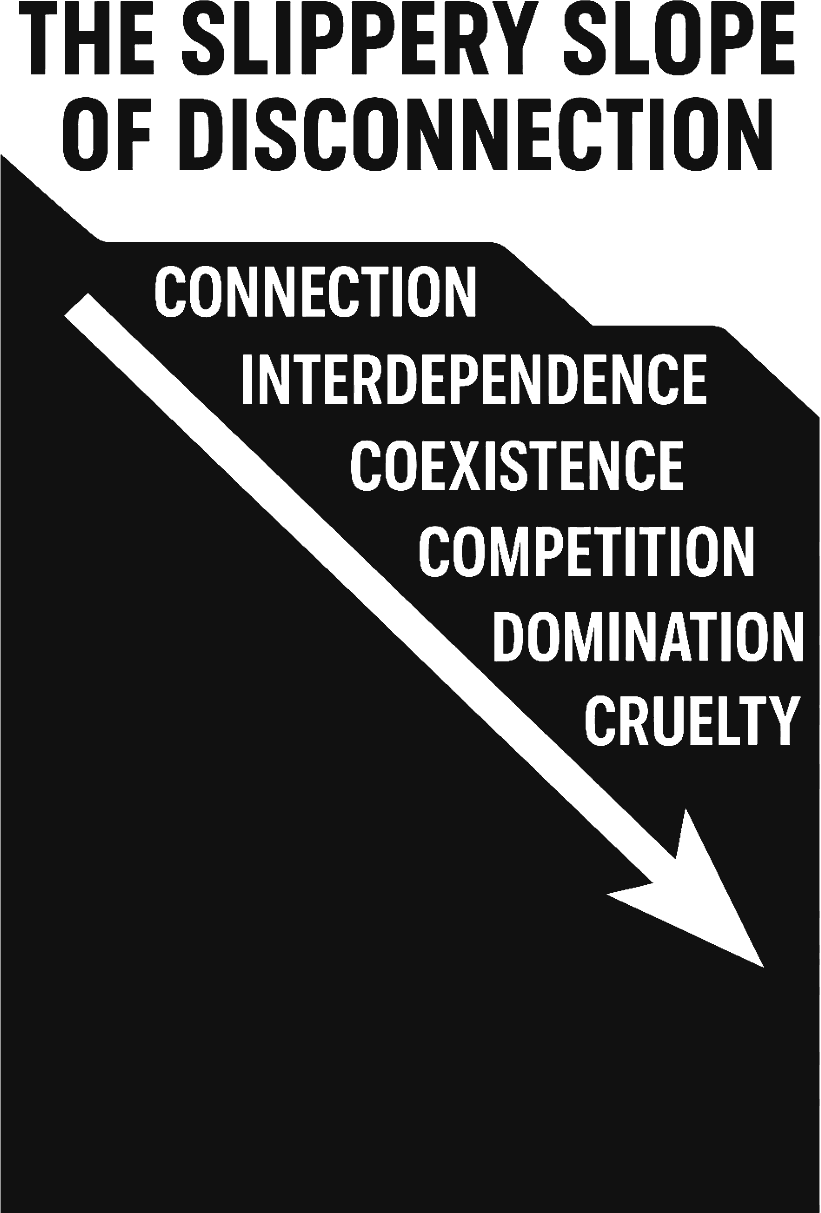
Connection - as we will discover later in this book, connectedness is a highly empowered and enlightened state. It expresses full confidence in individuality, while also being properly humble about what others (past, present, and future) might have to teach us. In the same way that an elite professional athlete is supremely confident in her capabilities and feels no egoic injury from constructive feedback – only a desire to get better at her game – humility and connection are intertwined. Everyone around us has something important to teach us. It could be as simple as patience. Or something much deeper and more subtle.
Interdependence – a step below connection, interdependence recognizes that we are part of an ecosystem. Our lives depend on trees and bees and the jet stream and the Ocean’s currents, and so on. Recognizing that we are not so independent that we can do whatever we want without repercussion is an important step towards connection. There is a sense of cooperation
Coexistence – here, we recognize that there are other entities around us. We may not cooperate with them, but we approach them with a “live and let live” kind of attitude.
Competition – now we’re getting into the kinds of behaviors we mostly see in the modern world. We view resources as scarce, and we identify that we need to compete with other entities for those resources. If there are bears or mountain lions encroaching on human settlements, we eliminate those threats. We also treat each other the same way.
Control – we seek to have command of the world around us, including other humans. We believe that we are superior to them, and that they should be ours to utilize as we see fit, without particular regard for their welfare.
Domination – think of the way slaves are treated, or the way conquered kingdoms were often treated in more ancient times, or the way colonialists treat their subjugated populaces. We act as though these other entities have no worth or value, except in service to us.
Cruelty – this takes domination a step further and adds humiliation, degradation. Think of the way Caligula treated his subjects, among many other unfortunate examples.
So, Where Does That Leave Us?
The results of our increasing division and short-term-mindedness have been decidedly large in scale. We are morally confused. We reward behavior that is self-evidently destructive, if we can just look past the immediate future. And yet, we innately care about our children and grandchildren, and even about ourselves a few years down the line. This is a real dilemma. We are operating on two competing, seemingly incompatible premises: get what I can right now, versus being connected to my (and my descendants’) future, and to everyone else (even if I only choose to relate to those who feel ideologically least challenging to me).
We live in a state of ever-increasing instability. We elect erratic leaders, who are true to no guiding or enduring principles, but rather only to immediate party- or self-interest. And, true to form, these leaders lead us to disarray, chaos, discord. And we are, very clearly, on a crash course with a force that can overwhelm us at any instant – mother nature. All of our weaponry and technological advancement cannot save us from the massive forces of hurricanes, tornadoes, pandemics, droughts, floods, heat waves, or atmospheric rivers.
How do we like the fruit growing from this tree that we’ve planted?
The modern world amplifies distraction, immediate gratification, disconnection and isolation. This happens through a multifaceted illusion that we, in the narrowest possible definition of the word “individually,” should optimize for material gain—right now, irrespective of what happens to our future selves, let alone everyone else. We are told to disconnect from aspects of ourselves that aren’t aligned with being a more productive employee, and with being less likable on social media. We are pumped full of lies about what we need and want, and these lies are incessant—coming at us from every angle, every moment of every day.
Even while researching this book, I’ve found myself pulled into attention vortexes—most recently after watching a video of Federico Faggin discussing consciousness. One click became many. Hours passed, and beyond the initial video—which was a thoughtful recommendation from a friend—nothing else added any real value. And I wasn’t watching cat videos—I was chasing meaning. But I still got caught. That’s how well these systems are tuned.
We could live in a world where our attention isn’t a commodity, and in which our lives aren’t shaped by algorithms aimed only at accelerating profit growth. But we don’t, not yet. And so here we are at a crossroads. We are in a place, right now, to make choices that will affect ourselves during our lifetimes, and which will profoundly affect the lives of our children, and theirs, and theirs. There is a solution, but will we rise to it? Or rather, will we reclaim it?